

INTRODUCTION
The flavor of meat is an important trait that influences the decision of consumers to purchase it [1]. Meat flavor is a complex trait that is influenced by many flavor precursors, which are controlled by many genes and environmental factors [2]. The flavor precursors in fresh meat are classified into water-soluble compounds and lipids [3]. Water-soluble flavor compounds include inosine monophosphate (IMP), inosine, hypoxanthine, amino acids, sugars, peptides (anserine and carnosine), and thiamine (vitamin B1) [3]. Generally, raw meat has a blood-like taste and no particular aroma [3]. The flavor precursors in fresh meat produce volatile flavor compounds on heating during cooking [3]. These volatile flavor compounds contribute to the four basic tastes (sweet, salty, bitter, and sour) [3,4], as well as to the umami (a Japanese word that means savoriness) taste, which is considered the fifth basic taste [4].
The red-brown Korean native chicken (KNC-R) is one of the five Korean native chicken lines; it is characterized as having tastier meat than broilers [5]. The unique taste of native chickens is due to higher content levels of flavor precursors [6]. Furthermore, KNC-R weighs more than other Korean native chicken lines [7]. The content of flavor precursors in chicken meat, including anserine, is influenced by intrinsic factors such as animal breed, sex, and muscle type, and extrinsic factors such as diet, cooking method, and storage [8]. Anserine is abundant in poultry [7] and is synthesized by the methylation of carnosine [9]. Anserine contributes to a bitter taste, but in combination with carnosine, it contributes to the formation of the umami taste [8].
Flavor precursors are influenced by both genetic and environmental factors [10]. Candidate genes related to the contents of different flavor precursors have been identified. For example, candidate genes influencing the IMP content in chickens include GPAT (PPAT), AIRC, and PURH (AITC) in Chinese Baier chickens [11]; ENTPD8 (ENTPD1), NT5C1A, AMPD1, and AMPD2 in Lueyang black-bone chickens [12]; and DUSP8 and IGF2 in Korean native chickens [13]. Moreover, the FADS1, SCD, and FADS2 genes influence different fatty acids involved in the formation of meat flavor, including arachidonic (C20:4), oleic (C18:1), linoleic (C18:2), and docosahexaenoic (DHA; C22:6) acids [14]. The candidate genes B4GALT4, B4GALTL, and IGSF11 influence the glycine content in Korean native chickens [15]; glycine is an amino acid that is involved in the sweet taste of meat [8]. Furthermore, candidate genes such as CRISP3 and CRISP2 influence threonine in KNC-R [15]; the amino acid threonine also contributes to the sweet taste of meat [8]. Free amino acids contribute to different tastes, such as sweet, bitter, sour, and umami tastes [8].
Previously, we identified candidate genes for the peptides carnosine and anserine in KNC-R; histamine N-methyltransferase (HNMT) and carnosine N-methyltransferase (HNMT-like) influence the carnosine and anserine contents, respectively [10]. Variants in the HNMT gene have been identified; a synonymous single nucleotide polymorphism (SNP) (rs735769522C>T) and a missense SNP (rs736514667A>G) were significantly associated with the carnosine content in KNC-R [16]. The anserine content of KNC-R breast meat has moderate heritability (0.24) [10], implying that the anserine content in chicken meat can be improved through genomic selection. HNMT-like protein is encoded by the HNMT-like gene and catalyzes the methylation of carnosine to produce anserine [10]. The HNMT-like gene is mapped on chromosome 7 of the chicken genome and is a novel gene that is thought to be a result of gene duplication [17]. The accession numbers of the HNMT-like gene (or LOC771456) are ENSGALG00000033461 for the GRCg6a chicken genome assembly in the Ensembl database and 771456 in the NCBI database.
Previously, we explored the HNMT-like gene in KNC-R and confirmed different variants using NGS data: one missense (rs737657949A>C) and three synonymous SNPs (rs317607580C>T, rs316762204A>G, and rs316857074A>G) [16]. The missense variant (rs737657949A>C) was genotyped, but this identified a single genotype (AA), so it could not be used to examine the association with the anserine content in KNC-R [16]. Few association studies have compared variants in the HNMT-like gene and the anserine content in chicken meat. Therefore, this study explored the possible associations between the three synonymous SNPs in the HNMT-like gene and the anserine content of KNC-R breast meat.
MATERIALS AND METHODS
The study obtained 384 KNC-R (192 males, 192 females) from the National Institute of Animal Science chicken farm in Pyeongchang, Korea. These chickens were from 2 generations or batches (generation 1, 192 chickens were hatched in 2021 and generation 2, 192 chickens were hatched in 2022). The rearing and management conditions were the same for all chickens as explained in our previous studies [10,13]. The chickens were slaughtered at 10 weeks of age and 100 grams were sampled from the breast of each chicken to determine the anserine and carnosine contents using nuclear magnetic resonance following the steps explained in [18].
Blood samples were collected from the jugular vein and stored at –80°C until DNA was extracted using the PrimePrep Genomic DNA Extraction Kit (GenetBio) based on the manufacturer’s instructions.
We used polymerase chain reaction allele competitive extension (PACE) genotyping to genotype three synonymous (rs317607580C>T, rs316762204A>G, and rs316857074A>G) SNPs in the HNMT-like gene using PACE assay mix and PACE master mix made by 3CR Bioscience (Table 1). PACE genotyping was performed in 96-well plates containing 1 μL DNA (5 ng/μL), 5 μL master mix, 0.25 μL assay mix, and 3.75 μL distilled water per well.
We used the formula in [19] to calculate the genotype and allele frequencies after genotyping the three synonymous SNPs in the HNMT-like gene. The formula in [20] was used to calculate chi-square (χ2).
To find possible effects involving the three synonymous SNPs in the HNMT-like gene, generation, and sex on the KNC-R anserine and carnosine contents, two-way ANOVA was used in R ver. 4.2.1 [21]. The mathematical model was used:
where Yijkl is the anserine or carnosine content, µ is the population mean, Gi are the genotype effects, Sj are the sex effects, gk, is generation effect, and εijkl is the residual error. We set a p-value < 0.05 as the significance level. We used Tukey’s test to identify genotypes with a significantly higher mean anserine or carnosine content in KNC-R. Furthermore, we applied Bonferroni correction for multiple comparisons.
Additive and dominance effects of the significant SNP on anserine and carnosine contents in KNC-R aged 10 weeks
For the synonymous SNP (rs316762204A>G) of the HNMT-like gene, the additive effect was estimated as the difference in mean values between homozygous genotypes. In contrast, the dominance effect was calculated as the difference in mean values between the heterozygous genotype and the average of the mean values in the homozygous genotypes as described in [22]. We also estimated the ratio of the dominance effect to the absolute value of the additive effect for the significant SNP.
where AA, AG, and GG are the mean values of the AA, AG, and GG genotype groups. Moreover, the proportion of total phenotypic variance (r2) explained by SNP was estimated by the following formula:
where r2: represents total phenotypic variance (r2) explained by SNP, SSGenotype: Sum of squares of genotype, SSTotal: Total sum of squares. If r2 is close to 1 or 100%, it shows a major effect of the SNP on the phenotype, and if the r2 is close to 0, it shows a small effect of the SNP on the phenotype.
RESULTS
PACE genotyping identified one genotype (CC) for SNP rs317607580C/T and three genotypes (AA, AG, and GG) each for SNPs rs316762204A/G and rs316857074A/G (Fig. 1).
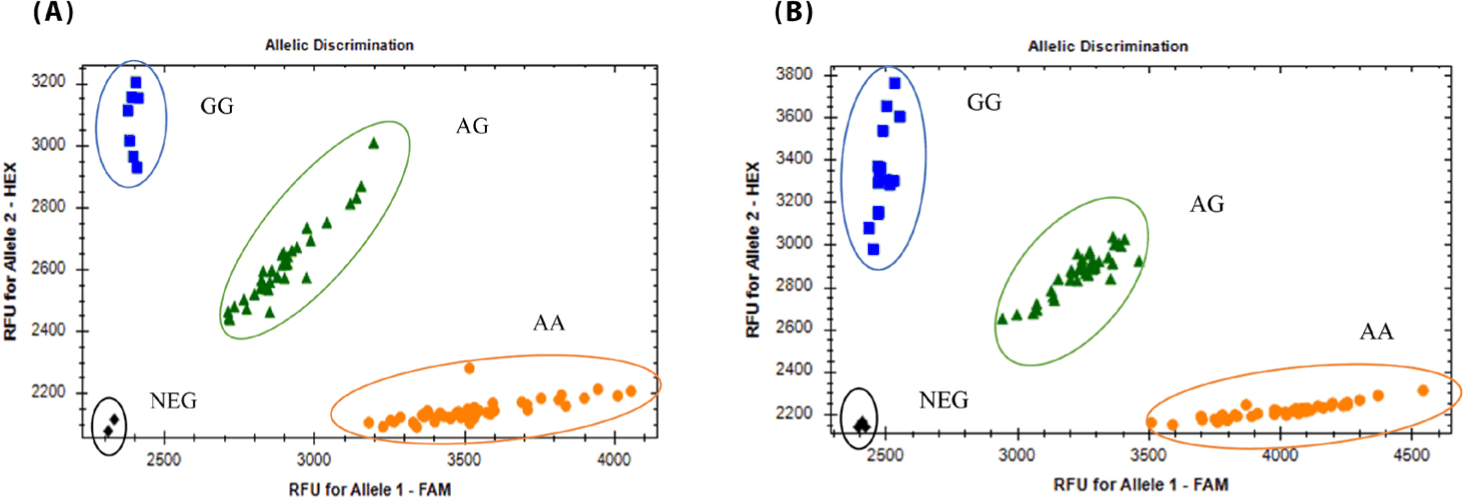
After genotyping, the genotype frequencies, allele frequencies, and HWE were calculated (Table 2). The C allele for the synonymous SNP rs317607580C/T was fixed in the sampled population. For the SNP rs316762204A/G, the heterozygous AG genotype was the most frequent, found in 46% of all genotyped chickens, followed by the AA (in 44%) and GG (10%) genotypes. For the SNP rs316857074A/G, the homozygous AA genotype was the most frequent (73%), followed by AG (26%) and GG (1%).
The SNP rs317607580C/T of the HNMT-like gene was not polymorphic and could not be used in the association tests. Therefore, the effects of SNPs rs316762204A/G and rs316857074A/G on the KNC-R anserine content were evaluated. We found a significant association (p < 0.05) with SNP rs316762204A/G while the effect of SNP rs316857074A/G was not significant (p > 0.05; Table 3). Our study did not find a significant effect of generation on the content of anserine and carnosine in KNC-R (Table 4). This might be attributed to the fact that the feeding and other management and even slaughter ages were the same for chickens across generations. Furthermore, the effect of sex on the anserine content in KNC-R chickens aged 10 weeks was not significant (p > 0.05) but female chickens had a significantly higher content of carnosine compared to male chickens (Table 4). These results are in agreement with our previous findings [16]. By conducting a power analysis for our sample size, using the “pwr” package in R, we found a power of 0.68 which shows an inadequacy of the sample size.
Anserine and carnosine contents are expressed as mg/100 g breast meat. Individuals with specific genotypes are shown in parentheses.
DISCUSSION
Genetic factors like breed or line and environmental factors such as feeding and muscle type influence the content of anserine in chicken meat [10]. Moreover, different candidate genes were reported to influence the content of anserine in the chicken breast meat of Korean native chickens [10]. In this study, we explored SNPs in the HNMT-like gene and assessed their effects on the anserine content in chickens. We identified three synonymous SNPs in the HNMT-like gene and evaluated their effects on the anserine content of KNC-R breast meat. Due to selection, allele C of the synonymous SNP rs317607580C/T was fixed in the population. The other two synonymous SNPs (rs316762204A/G and rs316857074A/G) were in Hardy-Weinberg equilibrium based on the χ2 calculation, due to a lack of gene flow, selection, genetic drift, and mutation [23]. For SNP rs316762204A/G, KNC-R with the homozygous AA genotype had a significantly higher anserine content than the GG and AG genotypes (Table 3). Furthermore, the Bonferroni correction for multiple comparisons confirmed the true genetic effect of SNP rs316762204A/G on the content of anserine in Korean native chickens with a Bonferroni-adjusted p-value of 0.04 (Table 3). The Males and females KNC-R did not have a significant difference (p > 0.05) in the anserine content, in agreement with published reports [7]. The synonymous SNP (rs316762204A/G) of the HNMT-like gene in KNC-R contributes to about 1.91% of the total phenotypic variance for anserine content (Table 3).
The HNMT-like gene is involved in anserine synthesis via methylation of carnosine [17]. Anserine is a histidine-containing dipeptide that is predominantly found in poultry meat [7, 24], as compared to beef and pork [24], and is a methylated product of carnosine [9]. The synthesis of anserine depends on the prior synthesis of carnosine [25]. Anserine is abundant in the skeletal and cardiac muscles of birds and mammals [25,26]; it is a natural antioxidant and has health benefits to humans because it has anti-aging and neurotransmitter properties [7]. As peptides, anserine and carnosine have antithrombotic, hypocholesterolemic, and antihypertensive actions [8]. Anserine functions as a pH buffer and inhibits glycation [27]. Moreover, anserine and carnosine contribute to the formation of the umami taste [8]. In this study, we estimated both the additive and dominance effects, as well as the ratio between dominance and absolute value of the additive effect (Table 3). When this ratio exceeds 1, there is over-dominance, between 0 and 1 indicates partial dominance, and a ratio less than 0 means under-dominance [28]. In our study, the ratio was between 0 and 1 (0.409), showing partial dominance, which means that the heterozygous AG genotype had a mean anserine level that was closer to the mean value of the AA genotype.
To meet consumer preferences for higher-quality, flavorful, and healthier meat, it is important to use genetic information to select and breed chickens that can meet consumer expectations in terms of meat quality. Synonymous SNPs can affect protein-folding, protein structure and function [29], and gene expression [30] and can therefore produce different phenotypes [30]. The SNP rs316762204A>G of the HNMT-like gene did not affect the amino acid sequence of the HNMT-like protein. The significant association between rs316762204A>G of the HNMT-like gene and anserine in KNC-R is probably due to linkage disequilibrium between this SNP and other genes mapped on the same chromosome that have significant effects on anserine [28]. Exploring SNPs in the HNMT-like gene and selecting KNC-R genotypes with higher anserine contents for breeding will improve the meat flavor.
Our research was limited by a sample size and the results should be validated in larger studies to detect a true effect of our significant SNP on the content of anserine in the chicken breast meat. Moreover, anserine is a new trait for the QTL and association studies, the association with gene expression is very limited. Further study is needed for the further identification of the genes affecting anserine and detailed expression analysis is also needed.
CONCLUSION
Anserine has a great effect on the flavor of chicken meat. Anserine is a natural antioxidant and has anti-aging and neurotransmitter properties and antithrombotic, hypocholesterolemic, and antihypertensive actions. Our study detected SNPs in the HNMT-like gene and explored their effects on the content of anserine in KNC-Rs. Homozygous AA genotype of the synonymous SNP rs316762204A/G in HNMT-like gene had more anserine in breast meat, compared to the GG and AG genotypes. The synonymous SNP rs316762204A/G might be used as a genetic marker in the selection and breeding of chickens with more flavorful meat.


