
INTRODUCTION
Pigs experience various stresses in modern swine production systems. Pigs are moved to another barn when transitioning to a different growth stage and are mixed with other pigs at that time, which may cause stress and behavioral changes in pigs [1,2]. In this situation, piglets often fight to establish a new social hierarchy, which potentially leads to injuries and physiological stress responses [1,3,4]. In addition, vaccination can also induce stress in pigs potentially due to the restraining or handling required during the vaccination process [5]. These stress sources result in behavioral changes, exacerbated stress, and eventually a decrease in the growth performance of pigs [5].
To cope with these stress sources, various methods have been tested to alleviate stress in pigs [6–10]. Among the methods, homeopathic remedies have been shown to effectively alleviate the negative impact of post-weaning stress and to improve the intestinal health of pigs [11–13]. Furthermore, a homeopathic remedy has been suggested to increase nutrient digestibility and mitigate various stressors of pigs [14,15].
The homeopathic remedy contains various biologically active compounds including Avena sativa, Ignatia amara, Silicea terra, and Medicago sativa, that have been shown to decrease stress-related biomarkers without adverse effects on the meat quality or growth performance of pigs [14,15]. A dietary homeopathic remedy containing Ignatia amara and Silicea terra reduced fighting behavior of nursery pigs [11]. A homeopathic product containing Avena sativa and Ignatia amara showed a reduction in weight loss after weaning [12]. Based on the stress-alleviating effects of this remedy, the homeopathic remedy may potentially have a positive impact on pig behavior. Therefore, the objective of the current study was to test the hypothesis that the supplemental homeopathic remedy enhances growth performance of pigs by improving hematological parameters and reducing stress related to vaccination and regrouping.
MATERIALS AND METHODS
The experiment consisted of 2 trials using a total of 94 pigs with an initial mean body weight (BW) of 16.5 kg (SD = 1.7) to obtain 8 observations for each dietary treatment. In trial 1, a total of 47 pigs (23 barrows and 24 gilts) with an initial BW of 15.5 kg (SD = 1.6) were allotted to three dietary treatments in a randomized complete block design using initial BW as a blocking factor with 4 replicate pens per treatment and 2 barrows and 2 gilts per pen using a spreadsheet-based program developed by Kim and Lindemann [16]. One pen for the basal diet group in trial 1 consisted of 1 barrow and 2 gilts.
Three diets based on corn, soybean meal, fish meal, and dried whey were prepared to contain 0%, 0.1%, or 0.2% of a homeopathic remedy (ConverMAX®) at the expense of limestone (Table 1). The remedy product contained 99.6% of limestone as the major carrier. The homeopathic remedy, obtained from Cargill, consisted of the following components at specific homeopathic dilutions: Picricum acidum 12 C; Medicago sativa 15 C; Avena sativa 15 C; Natrum muriaticum 15 C; Silicea terra 15 C; Calcium carbonicum 15 C; phosphorus 30 C; Chionanthus 30 C; Lycopodium 30 C; and Ignatia amara 300 C [15], where n C represents a centesimal dilution of 10–2×n. Energy and nutrient concentrations in all experimental diets met or exceeded requirement estimates suggested by the NRC [17]. Each pen (1.2 × 1.6 m) was equipped with a feeder and a nipple drinker. Pigs had free access to feed and water.
Vitamin-mineral premix provided the following quantities per kilogram of complete diet: vitamin A, 19,200 IU; vitamin D3, 3,840 IU; vitamin E, 172.8 IU; vitamin K3, 2.4 mg; thiamin, 3.36 mg; riboflavin, 7.68 mg; pyridoxine, 4.8 mg; vitamin B12, 0.048 mg; pantothenic acid, 24 mg; folic acid, 2.4 mg; niacin, 40.32 mg; biotin, 0.192 mg; and ethoxyquin, 1.44 mg; Co, 0.48 mg as cobalt sulfate; Cu, 72 mg as copper sulfate and 12 mg as copper-methionine; Fe, 120 mg as iron sulfate; I, 0.96 mg as calcium iodate; Mn, 72 mg as manganese sulfate; Se, 0.24 mg as sodium selenite; and Zn, 48 mg as zinc sulfate and 9.6 mg as zinc-methionine.
The homeopathic remedy consisted of the following components at specific homeopathic dilutions: Picricum acidum 12 C; Medicago sativa 15 C; Avena sativa 15 C; Natrum muriaticum 15 C; Silicea terra 15 C; Calcium carbonicum 15 C; phosphorus 30 C; Chionanthus 30 C; Lycopodium 30 C; and Ignatia amara 300 C, where n C represents a centesimal dilution of 10–2×n.
In trials 2, four additional replications for each dietary treatment were obtained employing 47 pigs (24 barrows and 23 gilts) fed the same experimental diets and housed in the same room as in trial 1. The initial mean BW of pigs in trial 2 was 17.6 kg (SD = 1.4). One pen of the basal diet group in trial 2 consisted of two barrows and one gilt.
Feed intake of each pen was recorded every day. On days 7, 14, 21, and 28, individual BW of pigs in each pen was recorded. Average daily gain, average daily feed intake, and gain-to-feed ratio were calculated for each pen. On day 14, all pigs were vaccinated intramuscularly at the neck muscle against classical swine fever virus (SuiShot® CSFV+SE-Live, Choong Ang Vaccine Laboratories). On day 21, blood samples were collected from the jugular vein of 1 barrow and 1 gilt per pen with and without ethylenediaminetetraacetic acid to yield whole blood and serum, respectively. After collecting the blood samples on day 21, a barrow and a gilt with lighter BW within each pen were moved to the other pen within the treatment for regrouping.
Pig behavior was recorded on d 0 (after the first regrouping), 14 (after vaccination), and 21 (after the second regrouping) using closed-circuit television cameras installed above each pen to investigate effects of dietary homeopathic remedy. An observer selectively analyzed the recorded behavior during 08:00 to 09:00, 11:00 to 12:00, 14:00 to 15:00, 17:00 to 18:00, and 20:00 to 21:00 h. The pig behavior analysis was categorized based on the criteria reported in previous studies [18,19] with modifications: (A) lying, defined as the pig lying on the floor; (B) feeding, defined as the pig’s head positioned in the feeder or engaged in gathering or chewing feed; (C) drinking, the pig’s mouth is in contact with a nipple drinker; (D) standing, where the pig remains stationary with all limbs on the ground; (E) roaming, moving freely without a bouncing motion; (F) scampering, running toward or away from other pigs; (G) fighting, involving reciprocal aggressive interactions between two or more pigs, excluding biting; (H) biting, the act of biting another pig’s body; (I) rooting, sniffing or rubbing the walls or floor; and (J) mounting, in which one pig mounts another with its front legs off the ground. The mild behavior included lying, feeding, and drinking; the active behavior consisted of standing, roaming, and scampering; and the aggressive behavior comprised fighting, biting, rooting, and mounting.
Diet samples were analyzed for dry matter based on the procedure suggested by Ahn et al. [20]. Crude protein (method 990.03), calcium (method 935.13), and phosphorus (method 946.06) in the diets were analyzed based on the procedures provided by the AOAC [21]. Concentrations of gross energy in the experimental diets were determined using a bomb calorimetry (Parr 6400, Parr Instruments). Whole blood samples of pigs were analyzed for complete blood count using VetScan Hematology system (Abaxis). Serum samples were analyzed for blood urea nitrogen, total cholesterol, creatine, glucose, and triglyceride using a modular analyzer (Cobas 8000 C702, Roche Diagnostics System). Cortisol in serum samples was analyzed using an enzyme-linked immunosorbent assay kit (Swine Cortisol ELISA Kit, Endocrine Technologies).
Data were analyzed using the MIXED procedure of SAS (SAS Institute). The model included diet as a fixed variable and trial and block within trial as random variables. The daily feed intake data were analyzed using a repeated measures analysis procedure over the entire experimental period [22]. The least squares mean was calculated for each treatment and the difference among the least squares means was tested using the PDIFF option of SAS with the Tukey’s adjustment. The experimental unit was a pen. Statistical significance was declared at p < 0.05.
RESULTS
The dietary homeopathic remedy did not affect the daily feed intake of the nursery pigs during the 28-day experimental period (Fig. 1). Growth performance of the nursery pigs was not affected by the supplemental homeopathic remedy (Table 2). The dietary homeopathic remedy did not affect the blood parameters (Table 3).
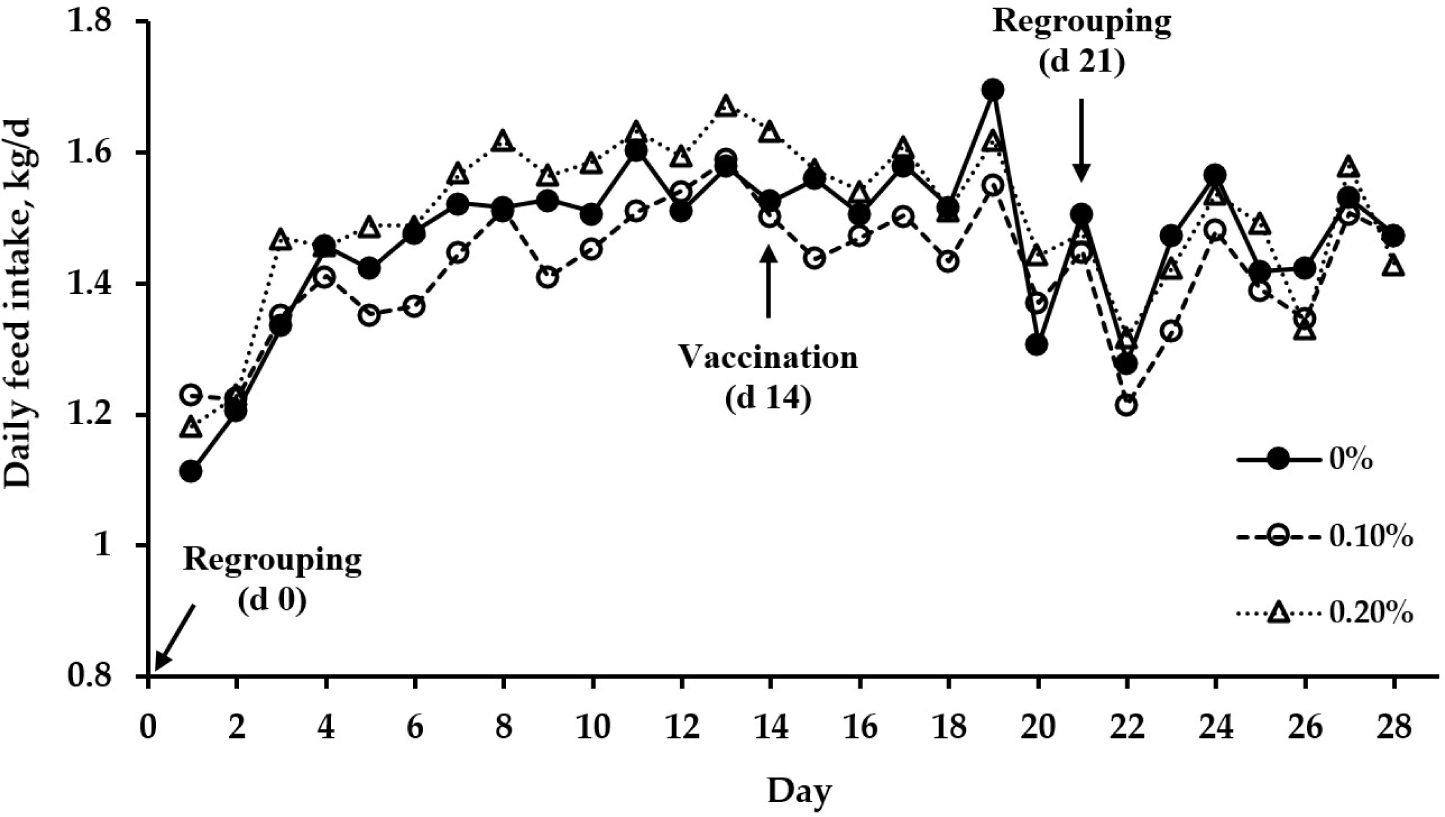
Each least squares mean represents eight observations (four pigs per pen) except for each pen of the basal diet in trials 1 and 2 (three pigs per pen).
The homeopathic remedy consisted of the following components at specific homeopathic dilutions: Picricum acidum 12 C; Medicago sativa 15 C; Avena sativa 15 C; Natrum muriaticum 15 C; Silicea terra 15 C; Calcium carbonicum 15 C; phosphorus 30 C; Chionanthus 30 C; Lycopodium 30 C; and Ignatia amara 300 C, where n C represents a centesimal dilution of 10–2×n.
The homeopathic remedy consisted of the following components at specific homeopathic dilutions: Picricum acidum 12 C; Medicago sativa 15 C; Avena sativa 15 C; Natrum muriaticum 15 C; Silicea terra 15 C; Calcium carbonicum 15 C; phosphorus 30 C; Chionanthus 30 C; Lycopodium 30 C; and Ignatia amara 300 C, where n C represents a centesimal dilution of 10–2×n.
The active behavior of the pigs fed the basal diet supplemented with 0.1% of the homeopathic remedy was higher (p < 0.05) than that of the pigs fed the basal diet after regrouping on day 21 (Table 4). When behavior data on days 0, 14, and 21 were pooled, supplemental homeopathic remedy at 0.1% increased (p < 0.036) the proportion of active behavior of the pigs but 0.2% of homeopathic remedy did not affect the behavior of pigs.
Each least squares mean represents eight observations (four pigs per pen) except for one pen of the basal diet in trials 1 and 2 (three pigs per pen).
The mild behavior consisted of lying, feeding, and drinking; the active behavior consisted of standing, roaming, and scampering; and the aggressive behavior consisted of fighting, biting, rooting, and mounting.
The homeopathic remedy consisted of the following components at specific homeopathic dilutions: Picricum acidum 12 C; Medicago sativa 15 C; Avena sativa 15 C; Natrum muriaticum 15 C; Silicea terra 15 C; Calcium carbonicum 15 C; phosphorus 30 C; Chionanthus 30 C; Lycopodium 30 C; and Ignatia amara 300 C, where n C represents a centesimal dilution of 10–2×n.
DISCUSSION
Pigs are often exposed to various stress sources such as regrouping when moving to another barn for transition [1,2]. In a previous study [23], transportation and handling during weaning increased the cortisol concentration, heart rate, and lymphocyte-to-neutrophil ratio of piglets. In addition, the transition from liquid milk or feed to solid feed can cause diarrhea and intestinal dysfunction in nursery pigs [24]. Furthermore, the piglets are housed with unfamiliar pen mates, leading to the establishment of a new social hierarchy. This regrouping can trigger stress-related behavior, such as biting, which can eventually increase tail losses and the occurrence of biting among pigs [25–27]. These stressors potentially reduce the growth performance of pigs, ultimately decreasing swine productivity. To mitigate the negative effects of these stress sources, the use of homeopathic remedies has been suggested [11–15,28].
The homeopathic remedy did not have any effect on the feed intake of pigs measured on a daily basis in the present study, which is in contrast to the observations in the previous studies for poultry and calves [29,30]. Supplemental Medicago sativa, an active ingredient in ConverMAX®, has been shown to increase feed consumption of broiler chickens [29] and BW gain of calves [30]. The reason for this inconsistency remains unclear. Similarly to feed intake responses, no effects on the growth performance of pigs were observed over the entire experimental period. Furthermore, the lack of effect of the homeopathic remedy on average daily feed intake during the entire experimental period was consistent with the findings of a previous pig study [15]. However, in another study [14], even though the same homeopathic remedy was used, the average daily feed intake of pigs was improved by supplemental homeopathic remedy. The reason for the inconsistency is unknown. Although anecdotal observations, dietary homeopathic remedy increased feed intake for 52-kg growing pigs [14] whereas not for nursery pigs in the present work and a previous study [15]. In another experiment [28], a supplemental homeopathic remedy increased BW gain only during the finishing period of pigs and was suggested to act as an immunostimulant. However, the mode of action of homeopathic remedies on growth performance remains unclear. Further research is warranted to investigate the interaction between BW and homeopathic remedies in pigs.
Although the effects of supplemental homeopathic remedy on the complete blood counts and other blood measurements in pigs were not observed in the present experiment, the blood values were within the normal ranges [31]. Considering that the observed hematological and growth performance values were normal, it is speculated that health status of the pigs used in the current study was good. On day 21, after collecting blood samples and regrouping, an increase in the proportion of active behavior was observed in pig fed the diet supplemented with 0.1% homeopathic remedy. However, no difference was found between the basal diet group and the 0.2% homeopathic remedy group. Serum cortisol concentrations between the basal diet and the diet supplemented with 0.2% of the homeopathic remedy were similar to each other, indicating that the homeopathic remedy may not affect stress. In a previous study [15], however, the homeopathic remedy reduced the road transportation stress of pigs, as evidenced by the decreased circulating cortisol. The reason for the discrepancy between the current and previous studies is partially attributable to the intensity of the stress. Pigs were transported in a moving truck for 2 h before blood collection in the previous study [15] whereas in this study blood samples were collected before regrouping in the morning on day 21. The pigs being transported in a truck would have been in a more stressful condition compared with those in the present study, which is also supported by the greater serum cortisol concentrations observed in the previous study (31.1 to 37.8 ng/mL) [15] compared with that in the present work (11.5 to 20.1 ng/mL).
The homeopathic remedy that was used in the present experiment increased nutrient digestibility and mitigated stress of pigs in previous studies [14,15]. Upadhaya et al. [14] reported that the biologically active compounds in the homeopathic remedy decreased serum cortisol concentrations without negative effects on the meat quality or performance of pigs under overcrowding conditions. Dang and Kim [15] also reported that the homeopathic remedy decreased serum cortisol of pigs exposed to 2 h of road transportation stress. These results indicate that the stressors in commercial conditions can be alleviated by supplemental homeopathic remedy. In the present study, the homeopathic remedy did not affect the growth performance of the pigs challenged with vaccination and regrouping. However, the types of stress sources in commercial swine farms are more diverse, including heat stress, high stocking density, and immunological challenges, whereas the potential stressors in the present study were limited to vaccination and regrouping. Therefore, the stress-alleviating effects of the homeopathic remedy may be more dramatic in commercial farms, which should be validated in future studies.
CONCLUSION
The effects of supplemental homeopathic remedy on growth performance and blood parameters of pigs were not observed. Supplementation of homeopathic remedy at 0.1% increased the proportion of active behaviors when pigs were regrouped but 0.2% of supplementation did not change the behavior of pigs.


